


















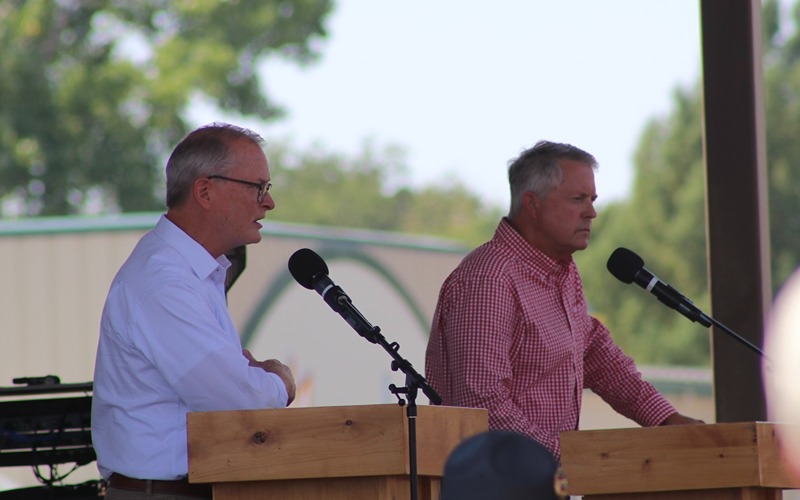
HUTCHINSON, Kan. – The Heartland Credit Union Pavilion on the Kansas State Fairgrounds in Hutchinson served as the stage for political debates highlighting key state and federal issues on Saturday. The day opened at 10:30 a.m. with the Kansas Gubernatorial debate between Cindy Holscher and Ty Masterson.
Following the gubernatorial forum, the U.S. Senatorial debate took place at 1:30 p.m., featuring incumbent Republican Senator Roger Marshall and Democratic challenger Adam Hamilton, a pastor of 38 years. The debate was moderated by Greg Akagi of WIBW, with questions presented by a media panel consisting of Michael Schwanke from KWCH, Dave Bergmeier from the High Plains Journal, and Tim Carpenter from the Kansas Reflector.
Opening Statements & Candidate Visions
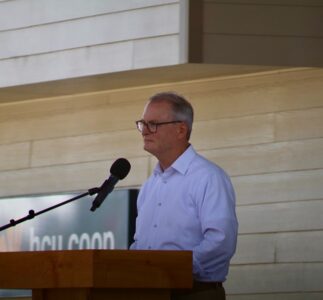
Adam Hamilton opened by detailing his family background, noting his 44-year marriage to his high school sweetheart, LaVon, their two daughters, and their granddaughter. Reflecting on his tenure as a pastor, Hamilton stressed that his decision to run stemmed from a desire to bring basic decency, moral leadership, and community service back to government. He voiced frustration over rising gas, diesel, and fertilizer expenses, as well as federal policies that he argued hurt Kansas families.
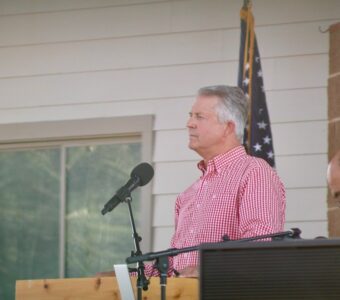
Senator Roger Marshall opened by highlighting his 25-year medical career as an OB-GYN in Great Bend, during which he and his wife raised four children and delivered 5,000 babies. Marshall emphasized traditional Kansas values, pointing to local schools, churches, and high school athletics as the cornerstone of the state’s communities. He framed the election as a clear choice between firm leadership and an opponent he characterized as weak and lacking clear convictions.
National Debt, $5,000 Dividend Proposal & Federal Budget
Addressing a proposal regarding President Trump’s proposed $5,000 dividend check, Hamilton sharply rejected the concept, describing it as an irresponsible attempt to buy votes that would add another trillion dollars to the existing $40 trillion national debt. Hamilton argued that if federal funds were available, they should be directed toward debt reduction, Medicaid benefits, or assistance for vulnerable citizens rather than direct payouts. Marshall responded by stating he approaches decisions by measuring twice and cutting once, maintaining that his primary focus remains on preserving Kansas jobs and supporting the state’s agricultural economy.
Regarding the broader national debt, Marshall criticized both major political parties for allowing federal spending to reach $40 trillion. He advocated for regular federal budget adoption and sustainable economic growth fueled by strong ag and manufacturing sectors. Hamilton countered that the national debt doubled during Marshall’s time in office, faulting recent congressional leadership for fast-tracking deficit spending.
Agriculture, Farm Bill & Beef Imports
Discussion shifted to agricultural policy, where Marshall criticized Senate Democrats for stalling the passage of a new Farm Bill. He questioned whether Hamilton would have the independence to stand up to Democratic leadership such as Chuck Schumer. Hamilton affirmed his support for passing a Farm Bill through bipartisan compromise, pointing out that recent federal decisions under current leadership resulted in 18,000 Kansas children losing SNAP assistance.
Hamilton criticized federal trade moves, specifically calling out the importation of 300,000 metric tons of beef, which he termed a slap in the face to local livestock producers during a vulnerable market period. Marshall attributed shrinking domestic cattle herds primarily to severe regional drought conditions and burdensome regulatory pressures imposed by federal environmental agencies.
Economy, Fuel Costs, Foreign Policy & Tariffs
On energy and foreign policy, Marshall warned that instability in the Middle East and nuclear developments in Iran threatened to drive domestic fuel prices as high as $20 per gallon. He defended traditional oil and gas production against regulatory restrictions. Hamilton cited direct economic impacts on Kansans, asserting that prolonged foreign conflicts and administration policies have added $650 million in fuel costs to the state’s economy, pushing diesel prices to $6 per gallon and driving up fertilizer costs for farmers.
Regarding trade tariffs, Marshall argued that international tariffs have successfully brought manufacturing jobs back to Kansas, citing recent industrial growth in Reno County, Fort Scott, and Wichita. Hamilton countered that 55 tariff adjustments over 18 months created severe market unpredictability, costing average Kansas households an extra $150 per month on consumer goods and burdening local agricultural equipment manufacturers with heavy import costs.
Healthcare, Medical Debt & NYT Report
Panelist Tim Carpenter raised a report from the New York Times detailing legal actions and collections pursued by attorneys associated with Marshall’s former medical practice over unpaid patient bills. Marshall defended his medical practice record, stating that one out of every five patients received free care, totaling $3 million to $4 million annually in charitable care. He dismissed the newspaper report as a political hit job and highlighted his legislative achievements, including securing $1.3 billion for Kansas hospitals and passing bills to lower prescription drug costs.
Hamilton criticized the aggressive collection practices, noting that standard business practices rely on payment plans rather than legal prosecution. He also criticized policy decisions that removed 51,000 Kansans from Medicaid coverage rolls.
Immigration & ICE Enforcement
Addressing labor needs in agriculture and meatpacking, Hamilton advocated for comprehensive, humane immigration reform. He supported establishing year-round H2A visa programs for agriculture and dairy producers while calling for Immigration and Customs Enforcement (ICE) to focus on its original post-9/11 counter-terrorism mandate rather than disrupting long-settled local agricultural workers.
Marshall stressed that strict border enforcement remains vital to protecting domestic jobs, community resources, and housing. He warned against open-border policies and maintained that legal immigration frameworks can only function effectively once border security is established.
Artificial Intelligence
Addressing technological shifts, Marshall argued for local decision-making and workforce training through community colleges, while emphasizing national defense measures to ensure the United States outpaces global competitors like China. Hamilton urged the immediate establishment of regulatory guardrails to mitigate AI risks, while questioning why recent federal bills awarded $30 billion in tax benefits to large data centers.
Separation of Church & State
Hamilton defended First Amendment protections, stating that government resources must remain neutral and not favor specific religious groups over others. He pledged to represent all Kansans regardless of faith background. Marshall highlighted America’s Judeo-Christian heritage, emphasizing faith as an integral element of public life and promising to defend family freedoms.
Farm Mental Health
Both candidates expressed support for addressing high stress levels among agricultural workers. Marshall highlighted the implementation of the 988 crisis hotline and praised outreach programs conducted by K-State Extension. Hamilton voiced support for the 988 lifeline while arguing that farm mental health crises are exacerbated by economic strain, high tariffs, elevated interest rates, and rising farm bankruptcies.
Closing Arguments
Adam Hamilton used a story based on the Wizard of Oz to frame his closing message. He argued that Washington urgently needs leaders with a “brain” to apply critical thinking over party loyalty, a “heart” to feel the struggles of ordinary citizens, and the “courage” to stand up to executive overreach and party leadership.
Senator Roger Marshall concluded by promising Kansans consistency, predictability, and unwavering support for agricultural interests. He reiterated his commitment to strong border security, reduced tax burdens, robust national defense, and the defense of constitutional freedoms.