


















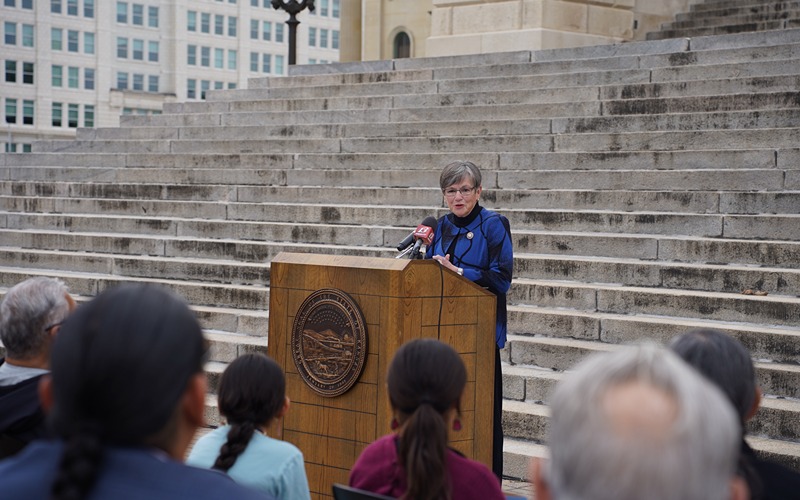
TOPEKA – Governor Laura Kelly announced yesterday the addition of eight prominent individuals to the Kansas Walk of Honor during a ceremony at the Kansas State Capitol. The governor was joined by individuals of the Kansas Historical Society, the Capitol Preservation Committee, family members of the honorees, and private donors who provided funding for the plaques to make the recognition possible.
The new honorees are Dr. James Naismith, Lucinda Todd, Georgia Neese Clark Gray, Clarina Nichols, Oliva Ann Beech, Minnie Evans, Chief Justice Kay McFarland, and Mary Skubitz.
“The honorees being added to the Kansas Walk of Honor have always been an important part of Kansas History,” Governor Laura Kelly said. “They broke down barriers, challenged injustice, led industries, and opened doors for generations to follow. Their contributions have shaped our state and our nation, which is why their names will forever be embedded in the sidewalks around the Statehouse, ensuring their stories live on in perpetuity.”
Located on the sidewalks surrounding the Kansas Statehouse, the Kansas Walk of Honor recognizes individuals who have made significant contributions at the state and national levels and have meaningful connections to Kansas. Established in 2011, the program is overseen by the Kansas Historical Society, with new honorees selected by the governor.
“Over the last fifteen years, we have honored seventeen Kansans from all walks of life who have made a significant impact on the state and to the country,” Patrick Zollner, Executive Director, Kansas Historical Society, said. “We are pleased to include these eight new honorees.”
The eight new honorees are:
- Dr. James Naismith: Invented basketball in 1891 and later became the University of Kansas’ first head basketball coach, establishing a sport that would reach audiences around the world.
- Lucinda Todd: A civil rights advocate and educator from Litchfield, Kansas, who challenged school segregation and was among the families involved in the landmark Brown v. Board of Education of Topeka Supreme Court case.
- Georgia Neese Clark Gray: A Richland, Kansas, native and Washburn University graduate who became the first woman to serve as United States Treasurer after President Harry S. Truman appointed her in 1949. Her signature appeared on all US currency throughout her tenure until the end of the Truman Administration.
- Clarina Nichols: A journalist, abolitionist, and women’s rights advocate whose efforts helped secure constitutional protections for married women’s property rights, women’s rights in child custody, and equality in public schools during the formation of Kansas.
- Olive Ann Beech: A pioneering aviation executive from Waverly, Kansas, who built Beech Aircraft into a major manufacturer. Beech became the first woman to lead a Fortune 500 company, supplying products for NASA and the United States military.
- Minnie Evans: Tribal chairwoman of the Prairie Band Potawatomi Nation who defended tribal sovereignty, pursued treaty claims with the Indian Claims Commission, and helped defeat federal efforts to terminate American Indian tribes, including the Potawatomi.
- Mary Skubitz: A labor rights advocate who helped lead the 1921 Amazon Army March, in which thousands of women connected to striking coal miners protested unfair labor practices across Kansas coalfields, leading to reforms such as the 8-hour workday, equality, and child labor laws.
- Chief Justice Kay McFarland: A Kansas judicial pioneer from Coffeyville, Kansas, who became the first woman appointed to the Kansas Supreme Court and the first woman to serve as chief justice. McFarland worked to improve public understanding of the law and supported greater access to Kansas courtrooms by allowing audio, video, and print photography.