

















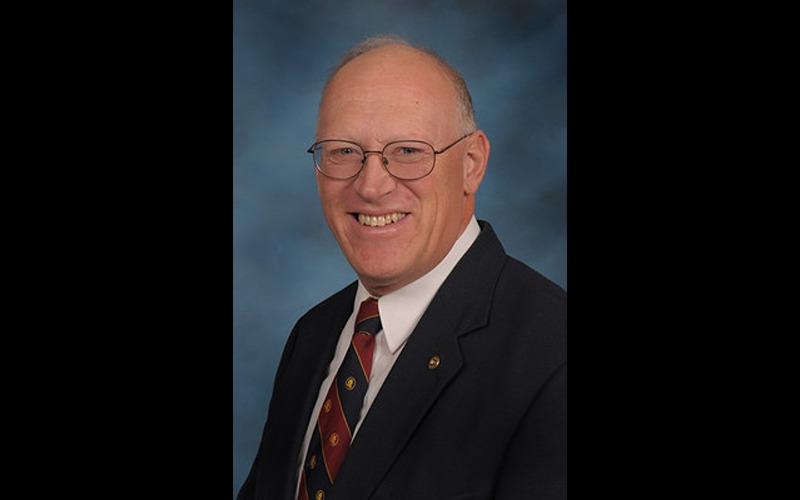
By Ron Wilson, director of the Huck Boyd National Institute for Rural Development at Kansas State University
As of today, there have been 1,791 editions of a weekly Kansas Profile – and this is the last one.
This writer is retiring from Kansas State University and from the Huck Boyd Institute, so the Kansas Profile series is ending. It has been my honor to write about Kansas ruralpreneurs and community leaders for the past 34 years.
As stated in that very first profile decades ago, I would like to salute the man who inspired it all: Huck Boyd himself.
McDill “Huck” Boyd came from the northwest Kansas town of Phillipsburg. Huck went to K-State but returned when his bank closed during the depression. He joined the family newspaper business, where he became editor and publisher of the weekly Phillips County Review.
His mother Mamie – a pioneering newspaperwoman for whom K-State’s Boyd Hall is named – taught him to make the most of every day. Huck did so and became deeply involved in his community, working on such issues as economic development, rural health care and more.
He became county chairman of his political party and worked his way up the ranks to become national committeeman for Kansas. U.S. senators and presidents called on him for advice. He was nationally influential from a rural setting.
In the1980s when the Rock Island Railroad took bankruptcy, it proposed to abandon 465 miles of rail line across the Heartland ‑‑ including Huck’s hometown. Loss of the rail line would have been damaging to the region.
I was working in Washington DC at that time, as a junior staff member for Senator Nancy Kassebaum. She introduced us to this man visiting from Kansas.
Huck Boyd.
He was in Washington leading the fight to maintain rail service for his region. The experts said it couldn’t be done, but Huck found a way. He even partnered with the governor of the other party to support a constitutional amendment to help make it possible.
Huck’s efforts were successful. Instead of abandoned track, today a private sector shortline railroad is operating on that line, with significant benefits to the region and state.
Huck passed away in 1987. The Huck Boyd Foundation was created in his honor. Among other things, the foundation supported creation of the Huck Boyd National Institute for Rural Development at K-State in partnership with K-State Extension. I became the Huck Boyd Institute’s first and only director in 1990.
In 1992, we initiated a weekly feature called Kansas Profile to feature and encourage Kansas rural entrepreneurs and community leaders. We didn’t know if this series would last for six weeks or six months or six years, but somehow it has continued ever since. Even as the Institute worked on other rural issues, this series has continued.
We have continually found remarkable rural-preneurs doing good things all across our state. That is a tribute to the resourceful and hardworking people of rural Kansas. My thanks goes to the wonderful staff people of K-State Extension news and radio for their assistance, and to the numerous newspapers and other outlets that have carried this column.
I am pleased that plans call for the Huck Boyd Institute to transition to a new model, where a K-State Extension community vitality specialist will be housed at the Huck Boyd Foundation office in Phillipsburg. This would provide a presence that K-State has not had in western Kansas in years.
The role of this specialist will be to support local extension units in their community development programming. This Kansas Profile column will not continue, but the specialists’ role will focus on addressing the current and future needs of rural communities in our state.
Just as Huck Boyd worked to advance rural communities, K-State Extension’s community vitality team will continue to provide science-based assistance for those communities through local extension units.
What characteristics give rural communities value? I believe they are places where families and businesses can thrive, where housing dollars go further, where family values remain strong, where multiple generations can work together, where traffic is light and commutes are easy, where streets are safe and schools are valued, where hard work and caring for one’s neighbor are at the heart of what people do.
Now, that’s rural.
Audio and text files of Kansas Profiles are available at https://www.huckboydinstitute.