


















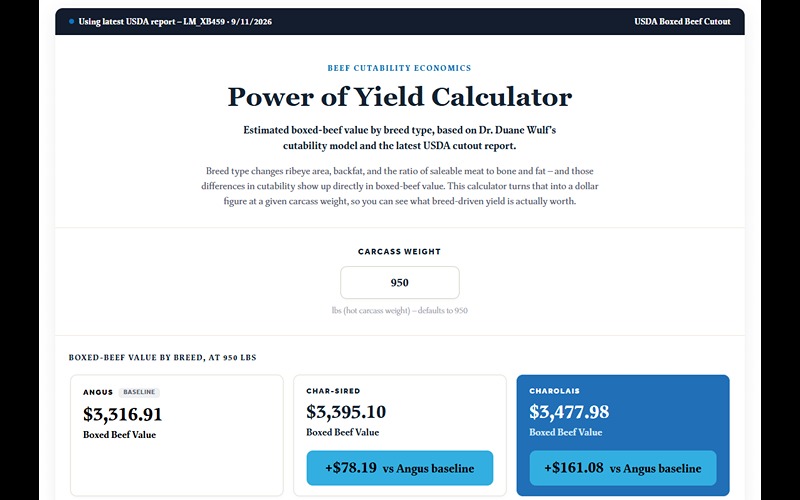
New interactive tool uses current USDA boxed beef values to demonstrate the changing economic value of breed-driven cutability and red meat yield
KANSAS CITY, Mo. — As the U.S. beef industry works to produce more beef with fewer resources, the American-International Charolais Association (AICA) has launched a new Power of Yield Calculator designed to put a current dollar value on one of the industry’s increasingly important economic drivers: red meat yield.
The interactive calculator combines breed-based carcass composition and cutability differences with updated USDA boxed beef values to estimate the economic impact of red meat yield at varying carcass weights.
Unlike a static research report based on prices from a single point in time, the Power of Yield Calculator incorporates updated USDA boxed beef market values, allowing cattle producers, feeders, packers and other industry stakeholders to see how the value of yield changes with the beef market.
“Quality grade has received tremendous attention from the beef industry over the past several decades, and rightly so,” said Brett Spader, Executive Vice President of AICA. “But producing high-quality beef is only part of the equation. We also have to look at how much saleable red meat we produce from every animal. As beef values increase, the economic consequences of differences in yield become increasingly significant.”
Turning Yield Into Dollars
The calculator is based on the cutability model developed by meat scientist Dr. Duane Wulf for AICA’s Power of Yield analysis. The model evaluates differences in carcass composition associated with breed type, including ribeye area, backfat and the resulting proportions of saleable meat, fat and bone.
Users enter a hot carcass weight and can then compare the estimated boxed beef value of Angus, Charolais-sired and straightbred Charolais carcasses. The calculator translates biological differences in carcass composition into an easily understood economic measure: dollars per head.
By applying updated USDA boxed beef values to the model, the calculator provides an evolving look at what additional red meat yield is worth under current market conditions.
“This is about making yield understandable,” Spader said. “A percentage difference in red meat yield can sound relatively small until you apply it to a 900-, 950- or 1,000-pound carcass and then put today’s boxed beef values behind those additional pounds. Suddenly, the economic impact becomes very clear.”
An Emerging Economic Signal for the Beef Industry
The calculator builds upon AICA’s original Power of Yield study, which compared expected carcass composition of average Charolais and Angus genetics at a constant USDA Choice quality grade and carcass weight.
That analysis demonstrated that differences in cutability can create substantial downstream value. Using USDA market values at the time of the original study, a Choice 900-pound Charolais carcass was projected to produce $152.47 more boxed beef value than a comparable Angus carcass, while a Charolais-Angus cross generated a $74.01 advantage over straightbred Angus.
Much of that advantage was concentrated in economically important products including ribeye, top round, strip loin, tenderloin, bottom round and lean trimmings.
The new calculator takes the next step by allowing those biological differences to be evaluated against changing beef values.
As boxed beef prices change, so does the value of producing additional pounds of saleable red meat. The result is a market-driven tool that helps demonstrate why yield deserves greater consideration alongside quality grade, growth and feed efficiency when evaluating cattle and genetics.
More Pounds — But More Valuable Pounds
The launch comes as heavier carcass weights continue to reshape beef production economics. Increasing carcass weight can create more beef per animal, but the composition of those additional pounds matters.
Adding weight in the form of saleable red meat creates a fundamentally different economic outcome than adding excess fat or other less valuable carcass components.
That makes genetics increasingly important.
Charolais genetics have historically been selected for growth, muscling and performance. The Power of Yield model demonstrates how those characteristics can translate beyond live and carcass weight into increased pounds of saleable beef.
The calculator allows users to see that relationship at different carcass weights and under current beef market conditions.
“We’ve spent decades talking about pounds, and pounds still matter,” Spader said. “The next question is: What are those pounds made of? The Power of Yield Calculator helps connect genetic differences in muscle and cutability directly to dollars. That’s an economic signal the entire beef value chain can understand.”
Connecting Genetics to Total Industry Value
The Power of Yield Calculator is part of a broader AICA effort to quantify the value genetics create throughout the beef production system.
Recent lifecycle modeling conducted by Kansas State University found Charolais and Charolais-influenced cattle generated the highest total industry value among breed types modeled, with the Charolais-cross advantage becoming particularly pronounced as cattle were taken to heavier carcass endpoints.
Together, the research provides two complementary views of beef industry economics: performance determines how efficiently cattle produce pounds, while yield determines how much value can ultimately be captured from those pounds.
For commercial cattle producers, those findings also reinforce the importance of genetic selection tools such as AICA’s Terminal Sire Index (TSI) and marketing programs such as CharAdvantage®, which are designed to connect genetic potential with economically relevant performance.
About the American-International Charolais Association
Empowering cattlemen with genetics that drive efficiency, profit, and confidence from pasture to packer. Charolais genetics are building what the beef industry demands — efficient, high-performance genetics that deliver at weaning and beyond. For more information, visit https://charolaisusa.com/