




Statewide program continues emphasis on education
MANHATTAN, Kan. (extension.k-state.edu) — The popular Walk Kansas program is adding four spring webinars to give participants a deeper dive into wellness topics ranging from physical activity at work to gut health and kindness on the job.
Sharolyn Jackson, a Kansas State University family and consumer sciences specialist and coordinator of Walk Kansas, said the educational component reflects the program’s continued evolution in its 26th year.
“We’ve added such an educational component to Walk Kansas over the last 5-10 years,” Jackson said. “I’m a believer that if people know the ‘why’ behind what we say, that’s going to stick with them more. We’re not just saying things. There’s a basis, there’s a research backing for all of this information that we provide.”
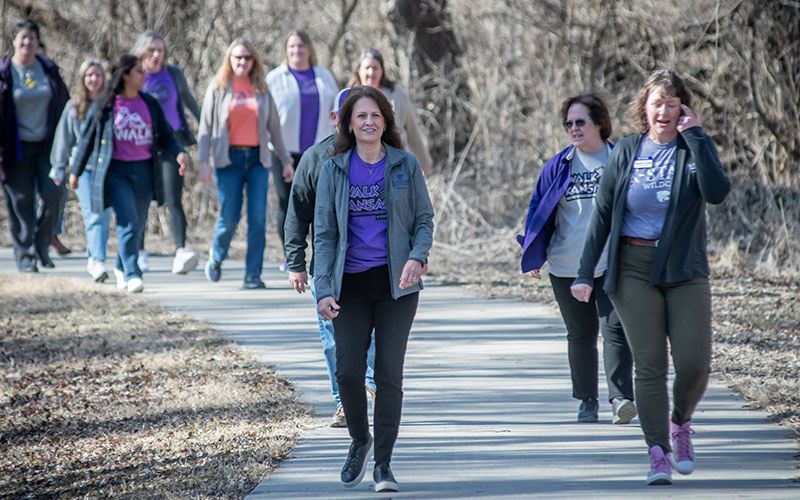
Registration for the eight-week health challenge opened March 1. The program runs March 22 through May 16 and is open to individuals and teams in Kansas and beyond. More information and registration details are available at walkkansas.org.
The $10 registration fee includes access to an online tracking system, a weekly newsletter, nutrition tips and recipes, and the four webinars, all scheduled during the noon hour on Wednesdays. The virtual room opens at noon, with presentations beginning about 12:10 p.m. and concluding about 10 minutes before 1 p.m.
“So for your $10 you’re getting all of this,” Jackson said.
The first webinar, April 1, is titled “Energize Your Workday: Movements in Nature for Focus and Vitality.” It will be presented by faculty in K-State’s Department of Kinesiology and is based on university research.
“They’re going to go into some of the science behind that,” Jackson said. “Why does a walk revive you more than a nap when you feel tired? How does regular exercise contribute to your productivity, either at your workplace or at home? How can you weave some of that physical activity throughout your day? Those are some of the key topics.”
On April 15, participants can join “Wiggle While You Work,” which highlights activities that can be done at a desk, including chair yoga, stretching and the use of hand weights or resistance bands.
“We know a lot of us spend quite a bit of time on Zoom,” Jackson said. “This is with your camera off, of course, but rather than just sitting there, I like to keep some hand weights close by and use those or some stretch bands to exercise.”
Jackson acknowledged that discretion and common sense are important in workplace settings.
“You’re not going to want to do these things if you do see the public quite a bit,” she said. “But a lot of people are maybe back at a desk or a cubicle, and they can certainly add some of these activities throughout their day.”
She said simple strategies — such as moving a trash can to the opposite side of the room or using a printer down the hall — can encourage more movement and break up long periods of sitting.
The April 29 webinar, “Good Gut Health,” will be presented by Chelsea King, a Johnson County extension agent and registered dietitian. Jackson said the session will explore how gut health influences immune function, autoimmune diseases, obesity and other chronic conditions.
“In addition to that, we know that the gut and the brain have a direct line for back-and-forth communication,” Jackson said. “So that is why your gut health also impacts your mental and physical health.”
The final webinar, May 6, focuses on “Kindness at Work,” led by Lisa Newman, a Central Kansas District extension agent, and Elaine Johannes, the Kansas Health Foundation Distinguished Professor for Community Health. The pair co-authored the publication “Kindness Matters,” available online from the K-State Extension bookstore.
“It seems kind of like, well, kindness at work is a no brainer,” Jackson said. “We see kindness as a simple virtue, but research shows us that it’s a whole lot more than that.”
Studies indicate that acts of kindness can boost the immune system, lower blood pressure, improve mood and even increase longevity, she said.
“I think of kindness as being something that is good for someone else, but it’s also good for us,” Jackson said. “It’s good for the giver and the receiver.”
Walk Kansas averages more than 4,000 participants statewide each year, ranging from young children to people in their 90s. Youth through high school may participate at no cost.
The program is built on the Physical Activity Guidelines for Americans, which recommend at least 150 minutes of moderate physical activity each week. Jackson describes moderate activity as working at a pace where a person can carry on a conversation, but not sing.
Nutrition and health research continues to evolve, she noted.
“Nutrition and health is a pretty new science, and so it is going to change over time,” Jackson said. “We try to bring what is the latest research, and what we have found to be the best research, the most sound.”
Among other activities planned this year is Walk to Work Day on April 3, with events on the K-State campus and in local extension units across Kansas.
“We try to bring what is the latest research,” Jackson said, “and help people understand why it matters.”