





The Kansas Department of Health and Environment launched the Child Care Zones program in 2025 to support communities working to address local child care issues. A Child Care Zone is a self-defined geographic area (of at least two counties) that receives state-level support to address challenges.
Applicants were required to demonstrate strong collaboration with community partners such as child care professionals, employers, local government, school districts and community-based organizations.
Child Care Zones are funded by a federal Preschool Development Birth through Five (PDG B-5) Renewal Grant, awarded to Kansas in 2024 and administered by the Kansas Children’s Cabinet and Trust Fund. While these grants will formally conclude in late 2026, communities are developing plans to sustain components.
The Child Care Zones program is demonstrating that community-driven innovation can help solve complex child care challenges when local partners and statewide systems align. Each zone is piloting creative strategies designed to address workforce shortages, expand access for families and strengthen business
models. Local innovations are helping shape frameworks for sustainable child care solutions across Kansas.
Funded Programs
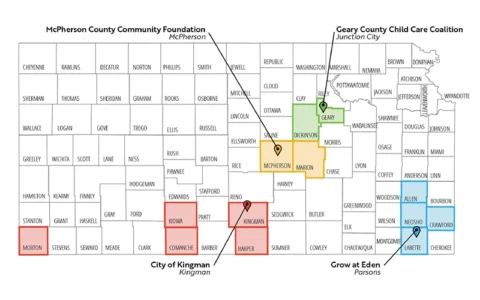
Kingman, Harper, Comanche, Morton and Kiowa
- Recruitment and Retention Bonuses that directly support licensed providers, increasing workforce stability.
- Operational Assistance to connect providers with funding, facilities support and small-scale renovation projects.
- Child Care Liaison Role to coordinate quality improvement and technical assistance.
- Employer Engagement linking local businesses to child care tax credits and public/private partnership models.
Labette, Neosho, Crawford and Allen
- Family Forward Navigator working directly with businesses to implement family-friendly policies and a pilot program for drop-in care.
- Regional Substitute Pool that unites providers with shared scheduling, payroll and quality systems.
- Quality Classrooms Initiative to launch a mobile, sensory lending library across three counties.
- Career Pathway Expansion through partnerships with Allen Community College and Registered Apprenticeships, offering hybrid college courses and laptop access.
McPherson and Marion
- Mentorship and Substitute Networks to stabilize the workforce and connect providers through peer learning.
- Extension Agents as Workforce Registry Ambassadors— to extend early childhood knowledge into the community.
- Coordinated Hub Planning to streamline business operations, data management and purchasing for small centers and family child care programs.
- Infant/Toddler Incentive Expansion and Multi-Site Small Center Pilot to optimize use of funds and donated community spaces (such as church facilities).
Salina, Ellsworth and Harvey
- Centralized Administration Hub to reduce time and costs for child care facilities through shared bookkeeping, payroll and business support.
- Non-Traditional Hour Incentives to encourage evening, weekend and overnight hours’ care.
- Wage Supplement Grants for both in-home providers and centers.
- Expansion of Benefits for providers to earn more, access mobile health care and receive gym memberships.
Geary and Dickinson
- Extended Care Pilot with three to five providers expanding morning, evening and overnight hours, supported by customized budgeting and marketing tools.Employer-
- Sponsored Child Care Cooperatives to engage at least 10 businesses in shared investment models.
- Universal Pre-K Curriculum Alignment to connect early learning providers with public school districts to promote comprehensive school readiness.
- Sustained Administrative Coordination through expanded staffing and partnerships with Live Well Geary County.
Stafford and Rice
- Strengthening School District Partnerships to launch licensed, in-school child care programs.
- Implementing High School-to-Career Pathways to create early childhood learning opportunities for local students.
- Regional Substitute Provider Network to create a pool of providers to help facilities stay open during staff outings.
- Employer Engagement and Endowment Fund to leverage local businesses and community foundations to seed a regional childcare endowment for long-term sustainability.
- Financial Supports for Providers to help them address health and safety needs in their facilities.
Cowley, Elk, Chatauqua, Sumner and Montgomery
- Establishment of Regional Hub for child care professional development and resource navigation.
- Entrepreneurial Support and Provider Capacity-Building to support businesses with licensing, shared resources and marketing support.
- Build Support from Economic Development Partners to help existing programs and expand child care workforce.
- Establishment of Early Years Village in each of the five counties to nurture communication and support for and between childcare providers and families.
Note: These strategies are currently underway and may evolve over the course of the grant period. To follow along with updates on strategies and progress, visit the All In For Kansas Kids website.