


















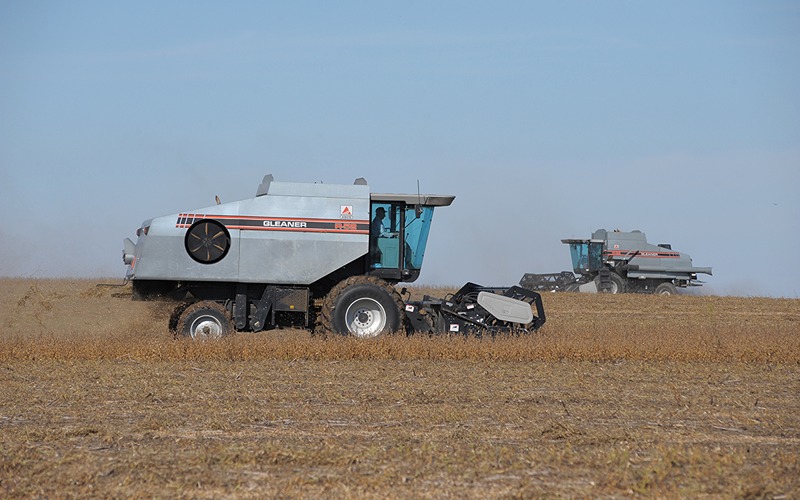
MANHATTAN, Kan. — Diesel fuel prices are likely to remain high for at least the next year, squeezing farmers’ profit margins and eventually hitting consumers in the pocketbook, according to a Kansas State University agricultural economist.
Diesel is currently about $2.25 per gallon higher than it was earlier this year, said Gregg Ibendahl, a farm management specialist with K-State Extension. Ibendahl monitors European natural gas prices as a driver for fertilizer prices and tracks global oil prices to estimate market shifts. He publishes regular updates on AgManager, a website maintained by K-State’s Department of Agricultural Economics.
Ibendahl says that while part of the increase in diesel prices can be traced to higher crude oil prices, the larger driver is a global shortage of diesel fuel.
“The price of oil has gone from the low to mid-$70s to more than $100 a barrel, and that probably explains about 70 cents of the increase per gallon,” Ibendahl said. “But diesel is up more than that. The rest is really because there just isn’t enough diesel fuel in the world right now.”
Global supply disruptions drive diesel prices higher
U.S. refineries are operating at about 98% capacity, “as hard as they can,” Ibendahl said. But global supplies have tightened sharply due to geopolitical disruptions.
Russia, historically a major exporter of diesel fuel, has reduced shipments after refinery damage from drone attacks during its war with Ukraine. In addition, flows through key shipping routes such as the Gulf region and the Strait of Hormuz have been curtailed.
“Russia is still producing oil but can’t get it refined easily because of damage to its refineries,” Ibendahl said. “They’ve essentially shut off diesel exports to Europe, and there’s not much moving through the Gulf, either. That’s created a very real shortage.”
At the same time, strong overseas demand is drawing U.S. supplies offshore. Ibendahl said about 30% of the diesel produced in the United States is being exported, tightening domestic availability and adding further upward pressure to prices.
Higher fuel costs squeeze farmers and consumers
For farmers, the timing is especially difficult. Fall is normally a period when refineries schedule maintenance on aging plants, often 50 years old or more. But this year’s strong demand and high prices are making it harder to slow down operations, even as farmers head into one of their peak seasons for diesel use.
“Farmers are price takers,” Ibendahl said. “They don’t get to set the price of corn or soybeans, so in most cases they just have to absorb higher diesel costs. They can’t really pass those on directly.”
In a typical grain budget for north central Kansas, Ibendahl said farmers might plan on using about four gallons of diesel per acre to grow corn. With diesel roughly $2.25 higher per gallon, that adds around $10 per acre in fuel costs alone.
“For a farmer working 2,000 acres, that’s an extra $20,000,” he said. “For many operations, that can be the difference between having a profitable year and not making anything at all.”
That said, Ibendahl says diesel is not the largest expense on most farms; fertilizer and seed usually rank higher. But the added fuel costs still have a meaningful impact on the bottom line.
Consumers, meanwhile, may not see a sharp jump in grocery prices due directly to grain costs, since raw commodities represent a relatively small portion of the final retail price. Instead, Ibendahl expects higher diesel prices to ultimately impact transportation and logistics.
“We move practically everything in this country by truck, and almost all of those trucks run on diesel,” he said. “If you’re a trucking company right now, you’re in a world of hurt. Those higher fuel costs will eventually be passed along.”
Major retailers may be able to absorb some of the shock initially, but Ibendahl said they cannot do so indefinitely.
“A company like Walmart might treat trucking as a small part of its overall business, but it still matters,” he said. “They can’t eat those costs forever. Over time, consumers are going to feel higher diesel prices, even if they’re not buying diesel themselves.”
Ibendahl expects diesel prices to remain elevated — possibly in the $6 to $7 per gallon range — for a year or more, barring a rapid easing of global tensions and a resumption of normal fuel flows from major producing regions.
“Even in a best-case scenario, where the war in Ukraine winds down quickly and shipments through the Gulf normalize, it could easily take six months for the market to adjust,” he said. “To see prices return to what we had earlier this year could take up to two years, even if everything goes right.”
A longer discussion with Ibendahl on diesel prices is available on the weekday radio program, Agriculture Today, produced by K-State Extension.