





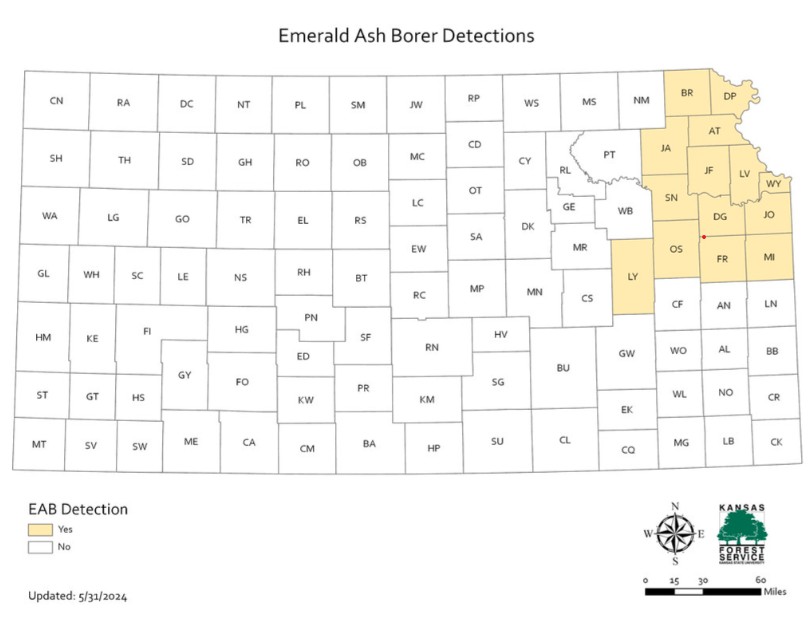
Latest discovery marks 18 Kansas counties with destructive beetle
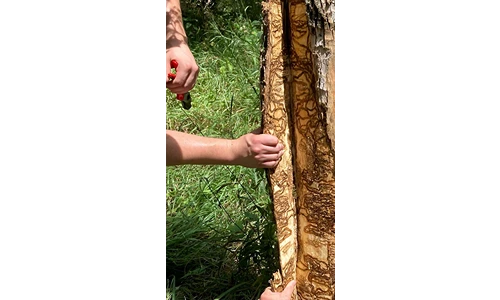
Kansas Forest Service officials peeled back tree bark to local emerald ash borer galleries, the feeding tunnels made by larvae. (Kansas Forest Service)
MANHATTAN, Kan. — The Kansas Forest Service has confirmed the presence of the emerald ash borer in Bourbon County on privately owned land north of Barnesville, the third confirmed sighting found in Kansas this year.
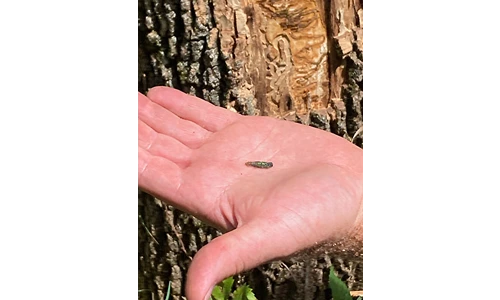
KFS, working with K-State Research and Extension, captured and confirmed one dead adult insect and several live larvae specimens on July 28. KFS officials first noted signs and symptoms of the pest and a follow-up site visit resulted in the official detection of verifiable physical specimens.
“It appears that the insects are now very much into their larval stage and are actively feeding on the vascular tissue of their host trees,” said Shad Hufnagel, forest health coordinator with the Kansas Forest Service. “This is the life stage where the real damage occurs as the feeding disrupts the tree’s ability to transport water and nutrients. Ash trees in the area we observed showed considerable decline.”
Earlier in 2025, state officials confirmed the presence of the emerald ash borer in Linn and Pottawatomie Counties.
The emerald ash borer is an exotic, invasive beetle from eastern Russia and northeastern Asia that likely was brought to the U.S. in infested packing material. The beetle threatens urban and rural forests by killing North American ash species and their cultivars.
KFS officials note that at least 70 million ash trees have already been destroyed due to the emerald ash borer, and as many as 9 billion North American ash trees will eventually be functionally rooted out and destroyed from the continent.
The discovery in Bourbon County makes 18 Kansas counties in which the emerald ash borer has been confirmed, including Wyandotte (2012), Johnson (2013), Leavenworth (2014), Douglas (2015), Jefferson (2015), Atchison (2016), Doniphan (2017), Shawnee (2017), Miami (2019), Jackson (2019), Brown (2022), Osage (2022), Franklin (2023), Lyon (2024), Nemaha (2024), Linn (2025), Pottawatomie (2025).
Forest officials say landowners should learn the signs and symptoms of emerald ash borer in their ash trees, including thinning canopies. As the feeding progresses, trees may begin to sucker (a process called epicormic sprouting) where branches appear near the trunk or lower canopy. Eventually, small D-shaped holes may appear in the bark.
According to Hufnagel, host trees will often decline over the course of a few years as the larvae stage of the insects feed on the vascular tissue of the affected trees. Unfortunately, early infestations are often difficult to identify.
Landowners are encouraged to create a replacement plan for the ash trees on their property to ensure a continually healthy canopy as ash trees decline. A landscape with many types of trees is more resilient to insect, disease and environmental threats that exist or could occur in the future.
“We will be conducting more site visits and inspections this fall so it will be interesting to see if we are able to confirm detection in more counties,” Hufnagel said. “This effort allows us to provide as much advance notice as possible to communities and landowners.”
Those seeking treatment or removal of ash trees in a county where the insect has already been detected should consult an arborist. A listing of certified arborists in Kansas is available online.
Landowners, especially those in counties where the insect has not already been detected, are encouraged to report suspected cases of emerald ash borer to the Kansas Department of Agriculture, or to the Kansas Forest Service.
All Kansans are reminded of the recommendation to avoid bringing firewood from another state or county where emerald ash borer has been previously detected. Use local sources for firewood.
The Kansas Forest Service, in partnership with K-State Research and Extension, continues to offer workshops and educational training in counties with detected populations of emerald ash borer, as well as those communities not yet affected by the pest.
More information on resources about treatment of infected trees is available online from the Kansas Forest Service.