

















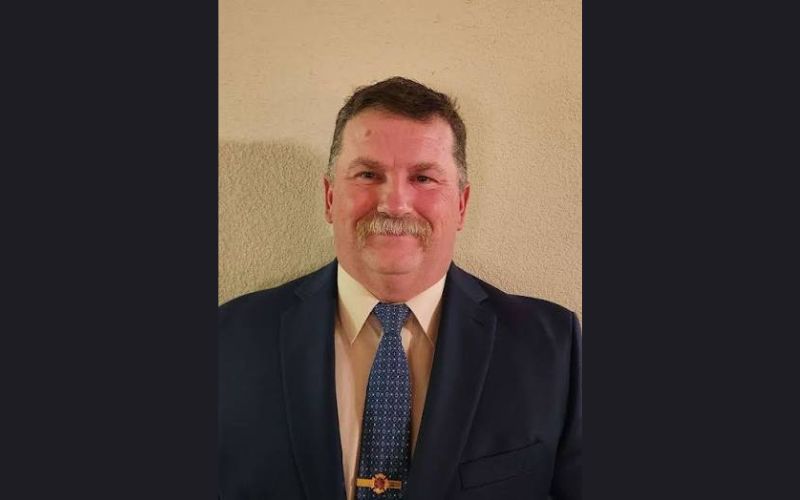
McPherson Fire Chief Chad Mayberry is the Kansas State Association of Fire Chiefs’ Fire Chief of the Year.
Mayberry arrived in McPherson two and a half years ago. He is also a second-generation firefighter.
Mayberry’s career includes helping merge Winfield’s fire department with hospital-based emergency medical services in less than six months.
In gratitude, McPherson Fire Chief Chad Mayberry penned this letter and shared it on Facebook:
Looking back, I have had a wide variety of experiences, both positive and negative, that have helped shape my career. I have had some amazing friends and mentors and have worked for some outstanding leaders. I have also encountered different leadership styles and approaches along the way, and each experience has helped shape my own philosophy of leadership.
In acknowledging this award, I cannot stress enough that what the McPherson Fire Department has accomplished during the two and a half years I have been here has truly been a team effort. I began my journey with the City of McPherson during a period of transition. My first boss was Mayor Tom Brown, who was nearing the end of his 16-year tenure as mayor when I was hired. I could not have asked for a more supportive boss. He gave me a lot of latitude and grace during my first year and a half as Fire Chief.
Likewise, the City Commission has been extremely supportive of the department during my time in McPherson. Our City Administrator started about a month before I did, our City Clerk started the same day I did, and we’ve had a number of other changes in city administration over the past two and a half years.
In January, we welcomed a new mayor. While Mayor Loving’s philosophy and style differ from Mayor Brown’s, his support of city staff has been equally strong.
Needless to say, both the Fire Department and the City of McPherson as a whole have changed significantly. There have been ups, downs, and growing pains, but overall, the change has been positive, and I believe the future is very bright.
Reflecting on this award, I’m going to share about as close to a full biography of myself as anyone will probably ever get out of me.
I am a second-generation firefighter.
I grew up on a farm west of Geuda Springs and attended school at Oxford Public Schools in south-central Kansas. My father served in the local volunteer fire department while I was growing up. During my freshman year of high school, he started a second career and went to work for Wellington Fire/EMS. He retired 20 years later as a Captain/Paramedic. One unique thing about him starting his career later in life is that our careers overlapped for several years.
While still in high school, I obtained my Kansas EMT certification through a night class at Cowley College. From there, I entered the Fire Science program at Hutchinson Community College. After my first semester at HCC, my short attention span and impatience kicked in, and I got bored. So, with very little notice to anyone, I walked away from a Presidential Scholarship and joined the U.S. Army Reserves.
Instead of returning to school, I reported to Basic Training in February. In hindsight, I can report that Fort Leonard Wood, Missouri, is not necessarily the best destination from February through April. The weather can be a little sketchy.
From there, I transitioned to Fort Sam Houston for Advanced Individual Training as an Army Combat Medic. Later in my military career, I reclassified as a 51M Firefighter, which let me connect my military service more closely with the profession I had already chosen on the civilian side. After graduating from AIT, I returned to Wellington in July of 1994 and immediately joined Wellington Fire/EMS as a Reserve Firefighter/EMT.
The Chief at the time told me my first couple of months would be mostly training and that I wouldn’t be responding to calls. That lasted about a week.
A major fire occurred at a large restaurant, conference center, and motel complex, and somehow I found myself riding the third apparatus to the scene. Granted, all of my duties were on the exterior, but it was still one heck of an introduction to the fire service.
That Chief has since retired from the department but continues to work with the Kansas Fire Rescue Training Institute. I have had the privilege of working with him in that capacity and feel blessed to call him both a friend and mentor.
In the fall of 1994, I returned to HCC and gradually worked toward completing my Associate of Applied Science Degree in Fire Science. True to form, I left again before finishing. In March of 1996, I was hired by the Parsons Fire Department as a Firefighter/EMT.
Three months into my career in Parsons, the U.S. Army graciously decided to deploy our unit to Bosnia for approximately 270 days. I got married on June 8 and reported for active duty on June 10.
I returned to the Parsons Fire Department in February of 1997. During my time there, I was promoted to Driver and Relief Officer and finally completed that Associate’s Degree I had started a few years earlier.
Parsons also exposed me to several significant events that had a lasting impact on my career. The most significant was responding to a double line-of-duty death in 1998. That incident affected many families, the department, and those of us who responded. I also experienced several major industrial fires, a downtown theater fire, and was on duty at Station 1 when an F3 tornado struck the city and the station itself.
In May 2001, I was hired by the Winfield Fire Department and returned to the area where I grew up. I spent most of my career in Winfield and advanced through the ranks from Driver to Lieutenant, Captain, and eventually Fire Marshal.
During those years, I completed my Bachelor’s Degree at Southwestern College, earned a variety of certifications, studied multiple fire and rescue specialties, and was fortunate to be an early graduate of the National Fire Academy’s Managing Officer Program.
Being located near the southern end of the Flint Hills meant plenty of major grass fires and a few wildland deployments around the state. Those experiences continue to serve me today, including through my work on the Kansas State Association of Fire Chiefs Wildland Committee.
I was fortunate to be among the department’s early members to earn Hazardous Materials Technician certification. Shortly after 9/11, a group of us traveled to Jackson, Mississippi, for HazMat Technician training. Over the years, I also had the opportunity to attend state-sponsored hazardous materials training in Pueblo, Colorado, as well as other specialty courses.
Around 2006 or 2007, the State of Kansas began placing greater emphasis on technical search and rescue. I had the privilege of becoming a founding member of Kansas Task Force 5. That led to structural collapse training, deployments to Greensburg, and eventually Hurricane Harvey as part of one of the early major out-of-state deployments for the Kansas Search and Rescue Task Forces.
Winfield also provided plenty of interesting incidents. As a shift officer, I somehow had the privilege of serving as Incident Commander (IC) the second time the Island Park Playground burned. Our initial response consisted of an engine and tanker with three personnel and no additional water supply. I also served as IC of a cotton gin fire where 66 cotton modules and a truck were lost. Needless to say, my total dollar-loss record as an Incident Commander is probably not something I should brag about on an award post. While serving as Fire Marshal, the community also dealt with a serial arsonist who made multiple appearances during my tenure.
As I look back, though, the incidents and certifications aren’t what stand out most about my time in Winfield. Once I promoted to Lieutenant, I spent approximately five or six years at each level before moving on to the next position. At the time, that sometimes felt slow. In hindsight, it was one of the best things that could have happened for my development because it gave me time to truly understand each position before advancing.
While serving as a Captain and Shift Supervisor, our department merged with the hospital-based EMS service to become Winfield Fire/EMS. That completely changed the department and the way we served the community. Being part of the leadership team that planned and implemented that merger on a timeline of less than six months was both extremely challenging and extremely rewarding. It also allowed me to support the growth and development of many people who are now officers in that department. Looking back, that remains one of the most rewarding parts of my time there.
I have already mentioned the Chief I worked for in Wellington. I was also fortunate to spend the majority of my time in Parsons working under one Chief who placed a strong emphasis on improving both the organization and its people. Likewise, during my formative years in Winfield, we had an excellent Fire Chief and a long-tenured City Manager. With strong leadership, a supportive administration, and a supportive governing body, it was a great environment to learn in.
One overarching theme I see when I look back on my career is the importance of timing, which is probably a good segue into McPherson. Toward the end of my time in Winfield, I was in a good place. I was comfortable in my role as Fire Marshal, working with people I respected, and I could very easily have stayed there for the remainder of my career. But I also knew I was ready for a new challenge.
Our son had established his career, our daughter was entering her senior year of high school, my wife’s job allowed her to work remotely, and the timing finally seemed right to see whether another opportunity might be out there. Fortunately, I was in a position to be very selective about where I was willing to move and what kind of opportunity I was looking for. I was not simply looking for another job. I wanted to find a community and an organization where I felt I could make a difference and where the fit felt right for my family and me. That opportunity turned out to be McPherson. The community was clearly poised for growth, there was tremendous potential, and the position felt like a great fit for me. I was genuinely excited about the opportunity and gladly accepted the position. What I found after arriving was a department with a very young workforce, tremendous untapped potential, and incredible energy. Looking back now, I believe the timing was right for both me and the department.
I came to McPherson during a period of transition. Change was happening within the department, within city administration, and within city leadership. Growth opportunities existed, but so did challenges that required patience, trust, and teamwork.
Patience, admittedly, has never been one of my strongest natural traits. I am impatient by nature and usually want things done yesterday. Working in municipal government has certainly helped temper that over the years. Having a spouse who somehow possesses even less patience than I do has probably helped as well. Between the two, I like to think I have made at least a little progress.
The past two and a half years have taught me a great deal about what it truly means to be a Fire Chief. Being Chief is less about having all the answers and more about surrounding yourself with good people, listening to them, trusting them, giving them opportunities to grow, and occasionally having enough wisdom to get out of their way.
We have made many changes within the McPherson Fire Department in a relatively short time. Some have been visible to the public. Many have not. We have worked on equipment, training, staffing, operations, community risk reduction, public education, professional development, and probably a dozen other things that sounded simple when we first talked about them.
More importantly, however, we have worked on culture. That work is never finished.
There have been disagreements. There have been growing pains. We’ve tried things that worked extremely well, and a few that probably looked better on paper than in practice once we actually tried them.
But through it all, I believe our department has kept moving forward.
One of the things that excites me most about the McPherson Fire Department is just how young our organization is. We have a very young staff, and with that comes tremendous energy, enthusiasm, and a willingness to learn.
They are eager to train, improve, and take on new challenges. More importantly, they bring an overwhelmingly positive attitude to work each day. That kind of energy is contagious.
Watching our younger firefighters grow in confidence, develop professionally, pursue additional training, accept new responsibilities, and begin stepping into leadership roles has become one of the most rewarding parts of my job.
They also challenge those of us in leadership to keep moving forward. They are not interested in simply maintaining the status quo, and quite frankly, neither am I. We still have a lot of work ahead of us, but when I look at the youth, energy, attitude, and potential within this department, I am extremely optimistic about where we are headed.
I am incredibly proud of the administrative team, officers, firefighters, and support personnel who make up the McPherson Fire Department. That is why this recognition is difficult for me to view as an individual award. My name may be engraved on it, but it has a lot of fingerprints. Fingerprints from Wellington, Parsons, Winfield, and McPherson. There are fingerprints from chiefs who took time to teach me, officers who challenged me, firefighters who trusted me, coworkers who told me when I was wrong, mentors who offered advice, and friends who listened when I needed to vent. City managers, mayors, commissioners, administrators, instructors, and countless others left their fingerprints on my career by providing opportunities or support. Most importantly, my family left their fingerprints.
A career in the fire service rarely belongs only to the person wearing the uniform. It involves missed holidays, interrupted meals, nights away from home, deployments, phone calls at terrible times, schedules that change at the last minute, and probably far too many conversations that begin with, “I just need to stop by the station for a minute.”
My family has supported me through it all.
More than 30 years ago, I was a brand-new Reserve Firefighter/EMT in Wellington who had been told I probably wouldn’t respond to calls for a couple of months. A week later, I was sitting on the third truck headed to a major fire.
I certainly did not know where that road would lead. I never imagined the Army, Bosnia, Parsons, tornadoes, line-of-duty deaths, Winfield, Task Force deployments, Hurricane Harvey, becoming a Fire Marshal, becoming a Fire Chief, or eventually standing before my peers to receive the Kansas State Association of Fire Chiefs Fire Chief of the Year Award.
I’ve had plenty of successes along the way. There have also been mistakes, disappointments, difficult days, and lessons learned the hard way. All of them helped shape me. I am incredibly humbled by this recognition, but more than anything, I am grateful.
Grateful for the opportunities.
Grateful for the mentors.
Grateful for the people I have served beside.
Grateful for my family.
And grateful that, after more than three decades in the Kansas Fire Service, I still enjoy this profession enough that if you ask me one simple question about Fire or EMS, you may immediately regret it.
Thank you to the Kansas State Association of Fire Chiefs for this incredible honor.
And thank you to everyone who has been part of the journey.
The award may have my name on it, but I certainly did not get here alone.