





TOPEKA — Lawmakers are attempting to resolve a water dispute between two Kansas cities and a neighboring county that has spawned three lawsuits, one administrative case and, most recently, a piece of proposed legislation that could modify county authority.
The outcomes could determine what roles state officials and local governments will play in securing quality water supplies for future generations.
One lawsuit has been dismissed, another is making its way through the court system, and the administrative case before the state’s Water Transfer Panel is in a holding pattern. But a bill that advanced out of a House committee Tuesday would amend state law to forbid county authorities from regulating water appropriation in ways that may conflict with state authorities.
In 1995, the city of Hays bought the 6,700-acre R9 Ranch in Edwards County, three counties south of Hays. The city intended to use the ranch’s 30 water rights to provide a public water supply to itself and the neighboring city of Russell, which could sustain them for an estimated 75 years.
In 2015 and 2016, the cities applied to switch the ranch’s water use from irrigation to municipal use and transfer 2,000 acre-feet of water, or roughly 1,000 Olympic-sized swimming pools, from southwestern Edwards County. The Kansas Division of Water initially approved the application, but it was challenged, and a final outcome is pending.
Since then, the ranch’s water — and the future of the cities’ water supply — has been uncertain.
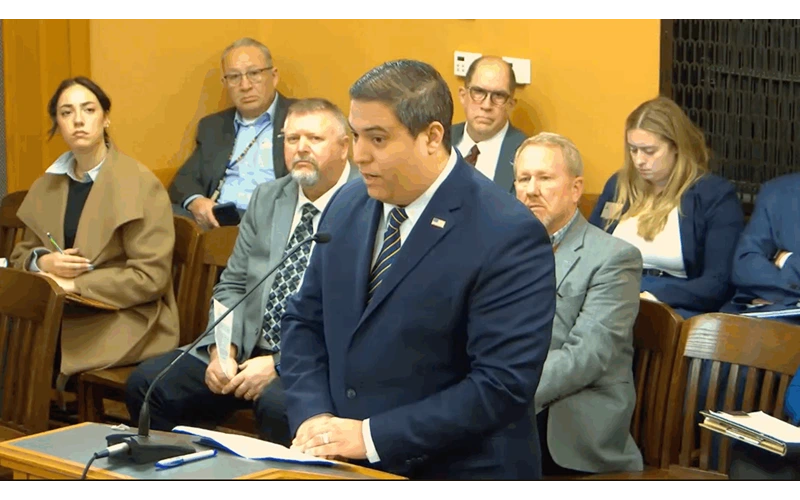
“Eleven years. Almost $11 million. That’s how much these court cases have cost the (cities) of Hays and Russell,” said Rep. Barb Wasinger, a Republican business owner from Hays, at a Jan. 28 hearing before the House Local Government Committee.
Under House Bill 2433, Kansas counties would neither be allowed to require any permits to transfer water through its rights of way nor impose any restrictions or fees on transferring water. If passed, the law would apply retroactively, affecting existing and future county resolutions.
Wasinger testified in support of the bill and said she wants to ensure counties don’t meddle with the state’s authority to settle water disputes. Simultaneously, she claimed it would not eliminate local control.
Wasinger and others repeatedly characterized the state as the owner of the water.
Water rights are property rights, said Earl Lewis, chief engineer for the Kansas Division of Water Resources, at the hearing.
“Once they’re established, they are a right that’s owned by some person or entity,” Lewis said, “and just like any property right — whether that’s land or whether that’s oil and gas rights — they can be sold.”
He said the question the state must answer in the case of Hays, Russell and Edwards County is whether it is in the state’s best interest to leave water where it’s always been or transfer it. It’s a public interest determination, said Lewis, who did not testify to the bill but answered committee members’ questions.
The bill ensures that determination remains with the state.
But it does modify county authority, said Micah Schwalb, a Colorado attorney whose firm represents a group of irrigators that go by the name Water Protection Association of Central Kansas, or Water PACK.
Attorneys for Water PACK, Edwards County, Hays and Russell argued before the Kansas Supreme Court in December.
Schwalb said by phone Tuesday that rural communities ought to “be able to determine their own destiny when it comes to use of their own rights of way.” He indicated the bill, if passed, could have implications for future data centers that may want to establish themselves in Kansas.
“If this legislation is allowed to pass, I think it’s fair to say that this will be one of many efforts to try to consolidate power in Topeka and remove local control in economic development decisions,” he said.
Russell city manager Kayla Schneider said a local business is ready and willing to expand, offering more employment and economic development in the area, but won’t because the city cannot guarantee an adequate water supply. The city has sought alternative water sources for years, Schneider said at a Jan. 28 hearing, but the R9 Ranch has been identified as their most viable solution long term.
“HB 2433 establishes clarity, provides stability, consistency, predictability, and respect for Kansas’ water governance structure,” she said.
Hays Mayor Mason Ruder said some of Edwards County’s actions, which include passing zoning restrictions on water transfers over a certain volume, duplicate existing state water law.
The county’s zoning changes, which passed in 2024, created a new requirement for municipal or industrial entities that want to move more than 500 acre-feet through a country right of way. It mandates they prove such a move won’t negatively impact the local economy, environment, cultural resources or public health before the county will issue a conditional use permit.
“The intent was clear,” Ruder said. “The goal was to force Hays and Russell to navigate a second regulatory process controlled entirely by the same county that is attempting to stop the project.”
Hays wants to build a pipeline to transmit water from the R9 Ranch’s aquifer to Hays. Despite the legal and administrative roadblocks, the city has applied for state and federal grants to fund $79 million of infrastructure to transfer the water. The state has vowed to contribute $15 million if the federal request for $63.2 million is approved.
HB 2433 would nullify the county’s zoning restrictions if passed, and, in theory, it would allow Hays to proceed with the water transfer, barring any judicial or administrative decisions to the contrary.
The bill was introduced in the House Water Committee in January, but it was assigned to the Local Government Committee. Eighteen people submitted testimony in support of the bill, including representatives from the Fort Hays State University Foundation, the Russell Regional Hospital, a local school district, utilities organizations and economic development groups.
Bob Rein, president of the Kansas Natural Resource Coalition and one of the two opponents, said the bill’s language presumed a conflict between state and county authorities and resolved that conflict in the state’s favor.
He called the bill dangerous, fearing unintended consequences of deleting an aspect of county home rule or the embedded authority to exercise self-governance.
Rep. Doug Blex, a wildlife biologist and farmer from Independence, said Monday the county’s actions border on overreach.
“You’re questioning the authority of the chief water engineer to regulate water, which I disagree with that statement,” he said to Rein.
The committee wouldn’t be hearing the issue if state rulings had been followed in the first place, he said.
Democratic Rep. Linda Featherston, a piano teacher from Overland Park, voted in favor of the bill.
“It’s very clear water belongs to the people of Kansas, not to any one county,” Featherston said. “It’s not about whether we think this is a good policy or a bad policy. It is just agreeing with the facts.”