


















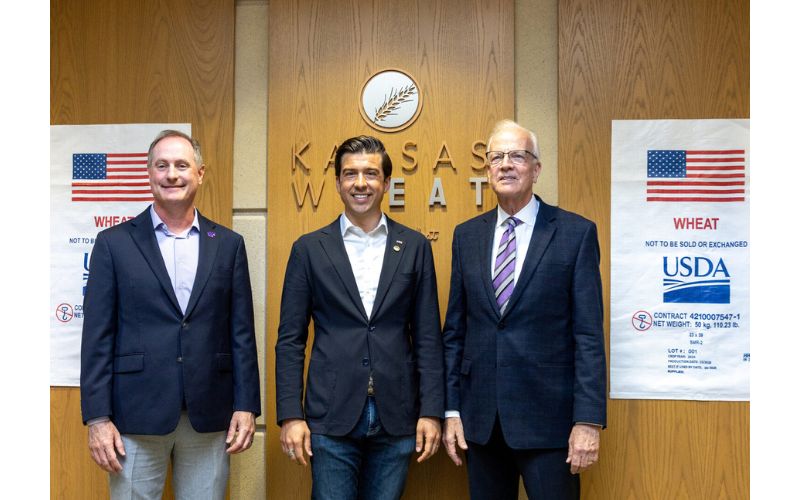
U.S. Wheat Associates (USW) helped welcome Luke J. Lindberg, USDA Under Secretary for Trade and Foreign Agricultural Affairs, U.S. Representative Tracey Mann (KS-01), and U.S. Senator Jerry Moran (R-Kan.) to the Kansas Wheat Innovation Center on May 27 for a roundtable discussion with agricultural stakeholders on trade negotiations and agreements, USDA administration of the Food for Peace program and other top-of-mind issues.
“We were excited to have Under Secretary Lindberg, Senator Moran and Congressman Mann visit the Kansas Wheat Innovation Center for an opportunity to talk about the importance of trade with leaders from Kansas commodities,” said Justin Gilpin, Kansas Wheat CEO. The Under Secretary has a unique understanding of why producers need to be able to sell our products around the world to consistent buyers, especially in these times when there’s so much volatility and geopolitical uncertainty.”
In addition to the global food security discussion, the delegation toured the Hal Ross Flour Mill, the IGP Institute and the Kansas Wheat Innovation Center. Throughout the day, the delegation discussed how the programs at these facilities reaffirm to the world that the United States is not just a seller of grain, but a dedicated partner in global food security.
“The Big First District is home to farmers, ranchers, producers, researchers, and agricultural leaders who help feed, fuel, and clothe the world,” said Rep. Mann in a release. “I was grateful to host Under Secretary Lindberg in the Big First today to show him firsthand how Kansas State University and our hardworking producers are strengthening America’s food supply and expanding our ability to meet the needs of a hungry world. Food security is national security, and Kansas producers are at the center of making sure American-grown commodities remain at the heart of our global food aid programs like Food for Peace.”
Global food aid programs were a highlight of the day’s discussions, particularly the shift of the administration of the Food for Peace program to the USDA. Earlier to this year, USDA announced the award of 30,000 metric tons (1.1 million bushels for emergency feeding programs under the Food for Peace program. The wheat is destined for emergency feeding programs in East Africa, which will be delivered by the World Food Program. Shipment is expected to take place this summer along with other commodities, including rice and sorghum.
“The delegation’s visit to Kansas is well timed, just ahead of the first trains set to load for a Food for Peace shipment from Kansas next month,” said Dalton Henry, USW vice president of policy and communications. “Farmers take tremendous pride in helping to feed the world. We are excited to see the deployment of Food for Peace program resources under the USDA’s administration, especially at a time of growing global hunger.”
Following their Manhattan visits, Rep. Mann and Under Secretary Lindberg toured the Dwight D. Eisenhower Presidential Library and ADM Milling in Abilene. Their final stop was the wheat farm of Greg Wilson, a Dickinson County farmer who represents the 70th District in the Kansas House of Representatives.
Wheat farmers have been champions of U.S. food aid assistance since before today’s programs came into existence. Food for Peace began with an idea from Cheyenne County farmer Peter O’Brien, whose proposal to use surplus American commodities to feed hungry nations was adopted by the Kansas Farm Bureau, sponsored in Congress by Kansas Senator Andy Schoeppel, and signed into law by President Dwight D. Eisenhower on July 10, 1954.
More than 70 years later, U.S.-grown wheat has remained an important commodity for food assistance, often representing half of the bulk in-kind aid and routinely using around one million metric tons of U.S. wheat annually.
“Kansas is at the epicenter of feeding the world,” Under Secretary Lindberg said. “Not only is it an exporting powerhouse for beef, wheat, corn, soybeans, sorghum, and other agricultural products that the world has come to enjoy; it’s also the home to the American generosity of the global food security movement. I am thankful to Representative Mann and Senator Moran for showcasing the best of Kansas to me this week.”