








This is quite a yarn. In fact, it is all about yarn.
This is the story of a fiber mill that spins various kinds of natural fibers into yarn, and ships it across the nation.
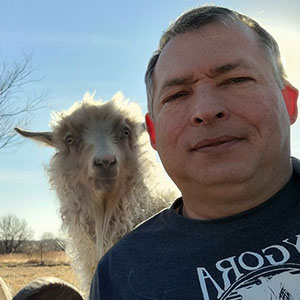
Roger and Penny Minniear are the founders, owners and operators of MM Fiber Mill near Louisburg. Roger grew up in Kansas City, Kansas. Penny grew up in Bucyrus. They met at a friend’s wedding.
Roger and Penny married, lived in Bucyrus and then moved to Louisburg. “I happily followed her out here,” Minniear said.
“We bought a couple of goats as pets and wanted to do something more with the land we had,” Minniear said. “We were at a fair in Topeka and the Pygora goat association had these tiny fiber goats.”
The Minniears bought some goats and then needed to shear them. “We started shearing twice a year,” Minniear said.
The next question was, what to do with the fiber? The fiber processors he contacted were all backed up.
“I started calling mills and they were saying, “Ship it to us and in a year or two we’ll get it back to you,’” Minniear said.
The Minniears began to think about processing their own. One day when they went to a goat show, the judge told them about a fiber mill for sale in northwest Kansas. The Minniears reached out to the sellers, spent time training with them, and bought the mill equipment in 2022.
“As I was going into the title company to finalize the deal, my realtor called and said that this historic building near us was coming up for sale,” Minniear said.
The timing was perfect. The Minniears purchased the building, which became the site of their fiber mill operation.
The building is the New Lancaster General Store, part of the historic settlement of New Lancaster in Miami County. New Lancaster itself is an unincorporated rural neighborhood of perhaps 20 people. Now, that’s rural. It is located seven minutes from the Minniear’s home in Louisburg.
Minniear expanded the goat herd, registered the animals, and started processing fiber for himself and others. He also added other animals, such as chickens, goats, cats, dogs and bees. “We have a menagerie out here,” Minniear said.
What to name the business? “Nobody can spell Minniear Menagerie, so we decided to call it MM Fiber Mill,” Minniear said.
MM Fiber Mill processes all kinds of raw fiber into yarn. “We wash it, clean it, pick it, card it, run it through the draw frame and spin it,” Minniear said. “We can handle all types of fiber, from alpaca to yak.”
He also blends products, sometimes adding commercially dyed fiber.
“We can add wool to give stretchiness to the fabric,” he said. He can use anything from merino to silk and bamboo. A retail section of the store offers fiber and other products, such as goat milk soap.
“I label some of the yarn by the goat (who produced it),” Minniear said. “People get a kick out of buying a skein of Josephine or Molly.” That’s definitely knowing the source of your product.
“I have a ton of local customers and we also ship product all over the country. We go from California to New York and Minnesota to Texas.”
MM Fiber Mill occasionally offers classes on felting and crocheting. As a registered Kansas agritourism business, it also hosts tours, from 4-H and school groups to American Girl groups.
“I like to work with and handle different kinds of fiber, and I’ve met so many new people,” Minniear said. “I come from the livestock side, some people come at fiber from the art side. It’s been a fun journey.”
For more information, go to www.mmfibermill.com or search for MM Fiber Mill on Facebook.
This is quite a yarn, and today we’ve learned about a man whose company spins yarn from various kinds of fiber. We commend Roger and Penny Minniear for making a difference by providing a valuable service to fiber producers.
They truly put a good spin on it.
Audio and text files of Kansas Profiles are available at https://www.huckboydinstitute.org/kansas-profiles. For more information about the Huck Boyd Institute, interested persons can visit http://www.huckboydinstitute.org.